
Servant Heart
More than a Mission Trip

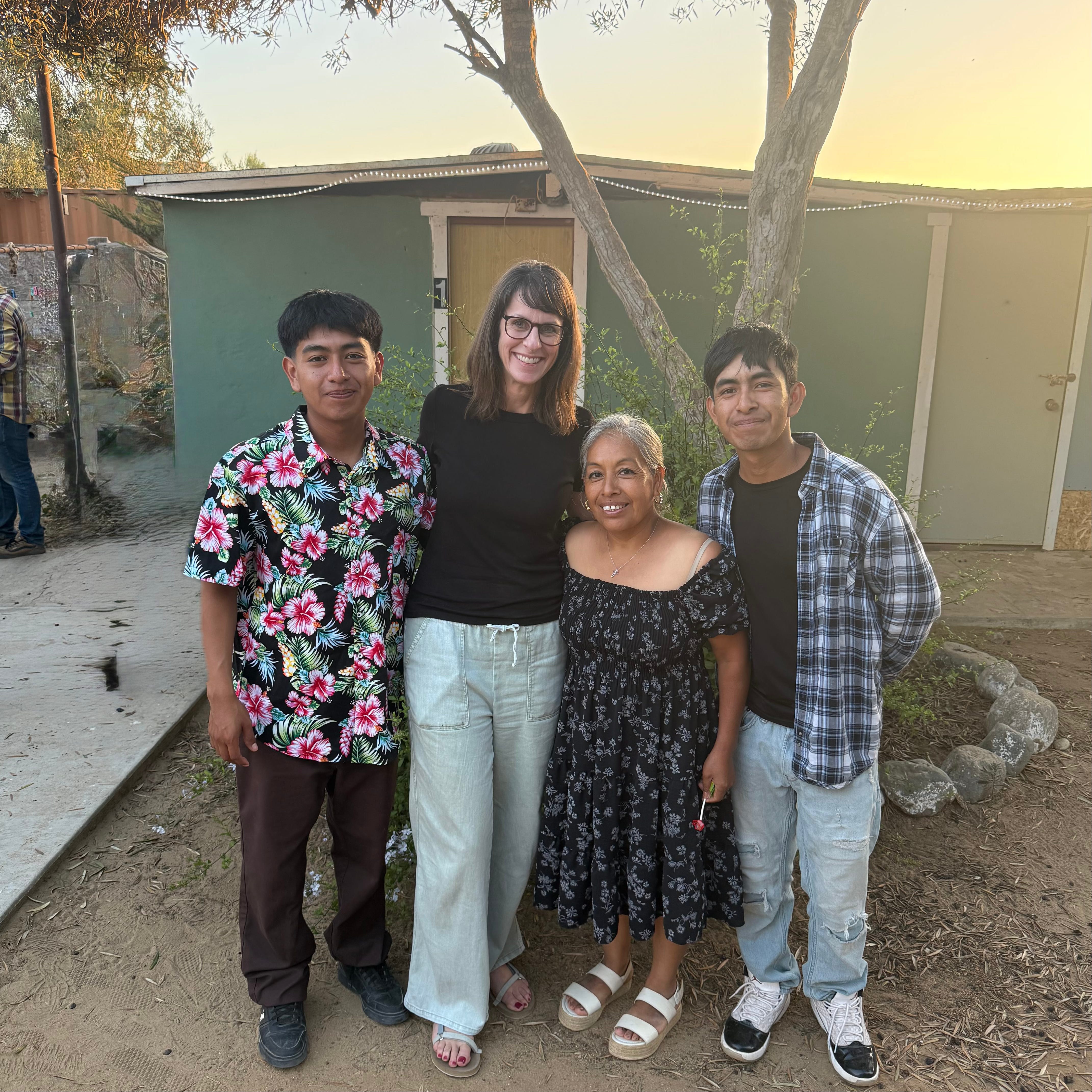
On our first morning in Mexico, I spent time with my friend, Dominga. We were an unlikely pair: two mothers, one short and one tall. We lived in two different countries, and yet, we held so much in common, especially the joy we found in service. A year had passed since we last saw each other, and I treasured being in her presence once again.
Our mission team had arrived in Vicente Guerrero, Mexico, the day before to build two houses. On Monday morning, Dominga and I began talking about our kids. She smiled and spoke first about her oldest son, Yony, a kind-hearted young man who had a good job in agriculture and a car that he let her borrow. With the same smile, she spoke about her youngest son, Julian. She loved his sweet spirit and was proud of his language-focused studies at the university. Our team enjoyed working with Julian and Yony, who served as our translators throughout the week. She ended the conversation by telling me more about her beautiful daughter, Bibiana.
Dominga then began bringing me up to date on the young girls in her Bible study group. She loves the young girls’ eagerness for God and life. The girls’ families are poor, and many are unaware of the world beyond their homes or schools. Dominga wants to build the girls’ confidence and provide them with real-world skills. She takes the girls to restaurants and teaches them how to order from a menu. She encourages them to save their money for larger purchases, such as movie tickets. One day, when each girl had saved enough money for an individual ticket, they piled into Dominga’s car, traveled two hours north, and watched their first movie in Ensenada.
Along with her Bible study group, Dominga enjoys volunteering in her hometown at both daycare and senior centers. Because of her service in the community, our group began serving at the senior center, a facility that houses twenty-five residents who would otherwise be homeless due to a lack of income and family support.
As I spent time with Dominga, I thought back to the prior year when we were in a similar situation. At the end of the week, we sat in the senior center’s open-air hallway and waited for the facility’s director to arrive. Our mission team fundraises all year long for the mission trip, with the intention that the funds be used for housing supplies and other needs in Mexico. The team wanted to use some of the funds to support the senior center’s monthly operating expenses. As Dominga and I waited, she spoke about working at the center for four years. She brought Julian and Yony to volunteer and treasured the interactions between her children and the residents there.
Dominga spoke about how much she enjoyed washing the residents’ feet, which she said would take all day. She would move from one person to the next, not only washing and massaging their feet but also listening to their stories and holding their pain and troubles in prayer. At that moment, her servant heart became more real to me. I glanced down at my pink shirt with white font that read “You can’t throw stones when you’re washing feet” and thought of all the times I had worn that shirt and how Dominga was the first person I had ever met who truly lived those words. When I related this to her, she blushed and said, “I don’t do it for any credit. I do it because I love them.”


Soon, the director arrived with his son. I handed him the blue envelope from our mission team. He opened the envelope and pulled out the thank-you card. He set aside the hundred-dollar bills and read the handwritten thank-you notes from each person on our team. He lifted his eyes and, in broken English, expressed his deepest thanks for the time we spent with his residents and the kind words written. The son, who spoke both Spanish and English, also shared gratitude for the donation, especially since one of their larger donors had decreased their giving.
The memory faded as Dominga drove me to the neighborhood where our mission team was working. During the ride, she mentioned not knowing exactly where the homes were located, but not to worry, she would find them. Her son Julian told her to turn right after the Coca-Cola billboard, and once we passed the strawberry fields, we would take a left to enter the neighborhood.
In Vicente Guerrero, street signs are rare, and numbers on houses and businesses are nonexistent. As we drove through town, I noticed how some cars had license plates, and others did not. When I inquired about the difference, Dominga said, “If a person has the money for a license plate, that is good, but if they don’t, that’s okay too.”
As we passed the fields, we talked more about her own work at Driscoll’s. She used to work in the strawberry fields, but now she plants raspberry seedlings. Her work day began before dawn as she rode the bus with other workers to the fields. She received 430 pesos per day (26 United States dollars) and a weekly pay of 2300 pesos (132 dollars) because the company deducts money for taxes and healthcare benefits. I had always heard about the low pay of field workers, and because of Dominga, now I know it is true. I treasured her sincere heart and began to see her not just as a great mother and hard worker, but as someone I was honored to call a friend.


As in past years, the mission teams built two 440-square-foot houses. I am always amazed how teams made up of twelve to fifteen people can arrive on Monday and transform a concrete slab and piles of lumber into a house by Thursday night. Since the houses are not plumbed and are often located in neighborhoods without access to electricity, families receive new outhouses and shower houses, along with solar panels that power charging stations for their mobile devices and one light bulb for each room in each house.
Our team likes to furnish the houses we build. Each team member packs items for the house in their suitcase, such as homemade curtains, sheets, and towels. One longtime participant packs a toilet seat for the outhouse. When we arrive at the build site on Monday, we determine additional items for the house, such as the number of mattresses needed and whether a two- or four-burner stove needs a new propane tank.
On Wednesdays, team members go shopping for furniture items. We search for a kitchen table, a dresser for each bedroom, and a small couch for the living area, all of which are delivered the following day.
One year, the store owner assisted in the delivery of a table and chairs. I invited her to come inside the house and see where the table would be placed. Through a translator, I explained to her how the mission team builds and furnishes family homes. This particular family wanted a large table to host guests for meals. Although the shop owner did not speak English and I did not speak Spanish, I could tell she was surprised to learn the story behind our purchase. With watery eyes, she stepped toward me and hugged me, while repeatedly saying, “gracious, gracious, gracious.”


A team member stepped outside with the shop owner and pointed toward the distant hillside filled with blue, pink, and green homes. Over the years, the mission teams had built those houses, and each house had one or two pieces of her store’s furniture. I had not considered what she thought of our group buying furniture over the years, but on that day, we all realized she had become part of our mission team in providing families with furnished homes in her community.
Once we complete building and furnishing the homes, we go grocery shopping with the families. Family members place desired items in a shopping cart, while team members follow closely behind and place matching items into a second cart, ensuring that the family receives a double portion of the items they prefer and need for their new home.


I remember the first year I went grocery shopping with a family: the mom selected a mop and, with a smile, placed it in her cart. This would be the first house where she could mop the floors. I thought about the mop resting in my closet back home and knew the next time I mopped my floors, I would definitely have a more grateful outlook while completing this household chore.
Thursday night is always the highlight of the week: the family cooks a homemade meal for the mission team.


Following the meal, our mission team and Baja friends conduct a house dedication service, exchanging words of gratitude, reading scripture, and praying blessings over the family and their new home. The family receives Bibles signed by the team members and their first house keys. We all wait with anticipation as the mother gets the honors of turning the key, and the family steps into their decorated and furnished home for the first time. Leaving them is difficult, but we eventually wave goodbye, hoping they rest well and enjoy their new home for years to come.
The week concludes with a love feast and worship on Friday evening, and groups depart for home early Saturday morning. The following morning, after a full 24-hour travel day, team members are resting in their own beds and readjusting to life on the East Coast once again.
Over the course of the next few days, weeks, and even months, team members share stories of dusty roads and newly built homes. Often, their stories are met with compassion, and someone usually responds by saying, "We never realize how blessed we are to live here in America."
There is truth in those words. Most of us in America enjoy the comforts of a roof over our heads, electricity, and indoor plumbing. Yet those conversations also invite me to reflect more deeply on what it means to be blessed. In Scripture, blessing is more than comfort or material provision. To be blessed is to draw near to God. Sometimes our daily conveniences deepen our gratitude and draw us closer to God. Other times, it is in places where comforts are few that God’s presence becomes especially clear.
I am deeply grateful for the modern conveniences I enjoy, for the opportunity to help families build stable shelter, and for the privilege of discovering what it means to be blessed, to be near to God, by serving alongside people like Dominga, Yony, and Julian. Relationships with God and with servant-hearted people like these are among the greatest blessings of God’s kingdom.
In the year 2000, a small group from Augusta Stone Church in Fort Defiance, Virginia, served for the first time in Baja California, Mexico. We give thanks for the late Emily Sterrett, who sensed God’s call to international mission and, through her research, discovered a house-building ministry that welcomed mission teams to Mexico. Since then, hundreds of people have left their homes in the states each summer, flown to San Diego, California, and traveled several hours down the Baja Peninsula to share the love of Christ and build relationships with the beautiful people of Mexico. The unforgettable week makes a lifelong impact on everyone involved, as teams of servant-hearted people from Mexico and the United States faithfully serve the Lord, house after house and year after year.
Reflection
How can you approach mission trips with a different mindset, not going to help or save others, but going to serve beside them and call them friends? When you use the word blessed, what do you mean? Does your understanding of blessing have more to do with comfort and possessions, or with drawing near to God?


This post weaves stories and pictures from the past five years of serving God in Baja, Mexico. It is difficult to say goodbye to an experience that has had such a faithful impact on our family. We have met some of the kindest, most generous people, from the families we built for to the friends we made along the way. Our lives have been forever changed by the people, the place, and God’s work among us.
Serve and Love Well,
Rev. April H. Cranford
Thank you for sharing this time in Baja with us. This is a great reminder that people can be extraordinary and warmhearted. This includes those who are served as well as those who serve.