
Rolling Grace
Sometimes the best way to see a big city, and each other, is from a wheelchair.

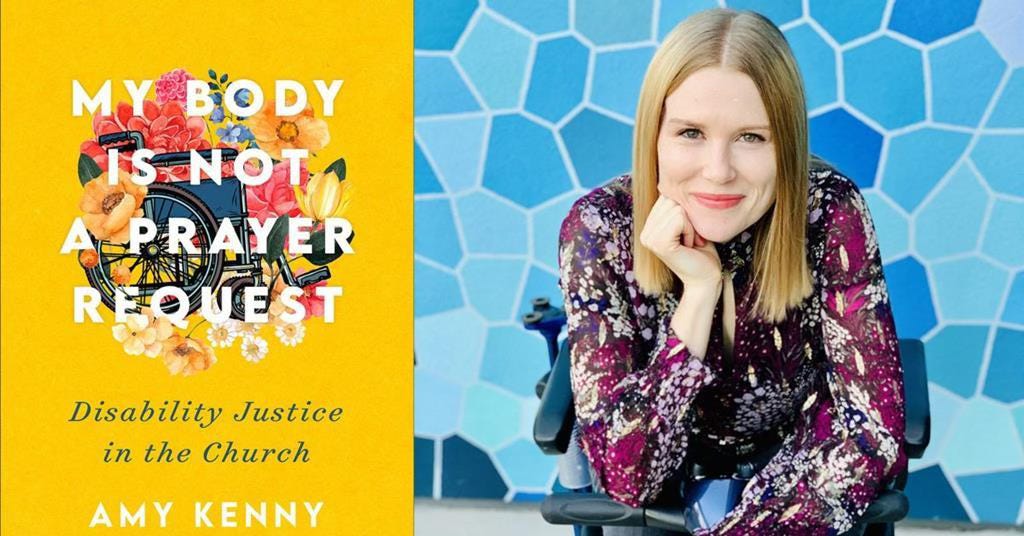
Dr. Amy Kenny, a Shakespeare scholar and disabled author, weaves theology and personal story throughout her book My Body Is Not a Prayer Request: Disability Justice in the Church. Diagnosed at age eleven with a rare circulatory condition, she walks short distances with a cane and uses a wheelchair for longer ones. Growing up, she often faced awkward church conversations where well-meaning people offered to “pray away” her disability. Yet Amy sees her disability as a way to reveal God to others.
Amy’s perspective reminded me of others who live with invisible disabilities and of one particular mission trip years ago when our youth group served in flood relief on Staten Island, New York.
Before the trip, I visited with a family in their home as we discussed the various ways Riley, a high school youth with Epidermolysis Bullosa (EB), might participate in the mission work. EB is a genetic skin disease where, in Riley’s case, she endures painful blisters on her feet whenever they experience heat or friction. Riley has lived with this very visible disease that often appears invisible to the world. As a child, she would wear flip flops or socks with sandals while other kids wore boots or tennis shoes.
Her mom, Kristi, who also has EB, recalls one winter day when a well-meaning stranger offered to buy Riley, who was wearing socks and sandals, a pair of shoes since she assumed the family could not afford them. Kristi graciously declined the offer, trying to explain that they had the means to buy shoes but that her daughter needed to wear sandals. The stranger scoffed and mumbled under her breath while walking away, “What bad parenting.”
When Riley was in first grade, Kristi thought it was important for her daughter to meet other people living with EB, so she signed her up for a conference in Nashville, Tennessee. She explained to Riley that many of the people there would be wrapped in bandages and might use wheelchairs all the time. During the conference, Riley saw many people, both younger and older than she was, with skin so fragile that they could not be exposed to the elements or put weight on their feet. The experience opened her eyes and left a compassionate mark on her heart. It shaped how she cares for her body and how she accepts her own limitations. When there is a lot of walking involved, she knows to choose other modes of transportation such as a wheelchair, bicycle, or scooter because the friction, pressure, and heat on her feet can cause large and painful blisters.
Back at school, Riley’s first-grade teacher would give her piggyback rides to and from other classes. Although this teacher’s kindness meant the world to Riley and her family, they decided it would be best for her to start using a wheelchair. For the next five years, classmates pushed Riley in her wheelchair to various classes, and she never felt any different from anyone else. That changed when she went to middle school.
In the county where Riley lives, many elementary schools feed into one middle school. During the first few days of her sixth-grade year, she continued using her wheelchair, but everyone seemed to stare at her instead of help her. She told herself that she would never use a wheelchair again, even if it caused painful blisters on her feet.
Fast forward to her senior year of high school and an upcoming mission trip with her church’s youth group, which included an all-day city tour in Manhattan. As shared earlier, prior to the trip, I visited Riley and her family where her medical diagnosis became the main topic of discussion. Everything seemed manageable regarding the mission work of painting walls inside homes damaged by Hurricane Sandy. Riley could wear flip-flops and remain in one spot painting or sit on the floor when needed. However, our conversation focused on the free day when we planned to take the ferry from Staten Island to Manhattan and enjoy a full-day tour of the city.
Riley had never been to New York City, and it was one of her lifelong dreams. Although she would have loved to join the high school youth touring the city on foot, she knew her feet could not handle the distance. In the past, she had endured assumptions and judgments while sitting in a wheelchair, as people often doubted her condition because she looked young and healthy. Still, she reasoned that she could look past the stares as she focused on the skyscrapers of the city.
Together, Riley and her family decided she would serve on the mission trip, and Riley agreed not only to use the wheelchair during the city tour but also to share her story with the youth the night before the trip.


The week began with tension, but her story changed everything. All week, Riley was anxious about the Thursday evening conversation with the youth group, but she knew it mattered. Along with EB, she has poor vision and must wear contacts or glasses to see clearly; otherwise, people appear as a total blur.
The night before the city tour, we gathered to talk about our free day in Manhattan. For some reason, Riley didn’t wear her contacts or glasses, and when she realized it, it was too late to return to her room. When her turn came to speak, an unexpected calm settled over her because she couldn’t see anyone’s faces. She began sharing about her EB diagnosis and how she used a wheelchair in elementary school without concern, but that changed in middle school. As she spoke, she realized that some of the faces before her were the same ones from middle school, a season when her pain was hidden and her presence often overlooked.
Although she couldn’t see their faces that night, a friend later told her that many of the girls had tears in their eyes. They hadn’t realized the pain she carried. Now, years later, Riley understands that middle school is a time when youth focus on fitting in, and whether they ignored her consciously or not, she doesn’t hold it against them.
She went on to explain that for the first time in a long while, she would use a wheelchair the next day and asked for their help pushing it around the city. Everyone agreed to take turns. The next morning, the guys offered to go first, joking about pulling wheelies. To Riley’s surprise, the group embraced the experience. Sharing the responsibility brought everyone closer together, and Riley, usually an introvert, cherished the one-on-one time she spent getting to know each youth and adult advisor.
Throughout the day, we encountered curbs that were not lowered and sidewalks that were uneven. Slowly, the group began to understand how challenging it can be to navigate the world in a wheelchair.
The turning point came at the subway station. There were only stairs. One youth looked around and asked loudly, “How does this city expect people in wheelchairs to get around?” That was the moment it clicked for him. For the first time, he truly saw the barriers Riley faced that day and throughout her life.
Years later, Riley shared that the day was transformative because it was the first time in years that using a wheelchair felt normal and good again. Being pushed through the city by the youth reminded her of elementary school, when classmates took turns pushing her wheelchair and she felt like one of them. The experience brought much-needed healing to very old wounds.
Thanks to her vulnerability and trust, our group witnessed more of God’s abundant grace during that all-day city tour than we had all week during our earlier relief work. Riley reminded us that, as beloved children of God, we all have both dreams and limitations. Yet together on that day, one of hers came true. Thanks to a youth group and a brave young woman who sometimes uses a wheelchair.


A Rephrasing of Matthew 25:43–45:
Depart from me, for I was in a wheelchair and you gave me no ramp.
I was deaf and you gave me no interpreter.
I was blind and you gave me no visual descriptions.
I needed an accessible bathroom and you did not install one because it was too expensive.
I asked you not to insult me by saying “lame,” and you laughed at me.
I wanted to be included, and you said it would violate your faith commitments.
I was disabled, and you did not accommodate me.
—from My Body Is Not a Prayer Request: Disability Justice in the Church by Dr. Amy Kenny
Upcoming domestic and global mission opportunities.
If you are looking for a way to make a tangible difference in someone’s life right here in our community, I invite you to serve during one of the upcoming cold weather shelter weeks sponsored by Waynesboro Area Refuge Ministry.
Westminster Presbyterian Church in Waynesboro will host the shelter December 15–22, 2025. Check out the volunteer and donation opportunities here: https://www.wp-church.com/post/coldshelter2025
If you feel called to serve on a mission trip, join us for an upcoming Baja Gathering on Sunday, November 16, at 5:30 p.m. This in-person meeting is a great opportunity to learn more about the Baja, Mexico mission trip and reconnect with past participants.
Where: Westminster Presbyterian Church Chapel (enter through the red doors)
Address: 1904 Mt. Vernon Street, Waynesboro
When: Sunday, November 16
Time: 5:30–7:00 p.m.
What: A relaxed, low-key gathering to get to know others, learn about the 2026 Baja Mission Trip (July 12–18, 2026), and review past fundraisers while planning for upcoming ones.
Food: Bring your favorite dish to share. Drinks and paper products will be provided.
If you are unable to attend but would like to learn more about Baja, please visit the updated information on the Shenandoah Presbytery website at www.shenpres.org/baja or email the leadership team at bajaleadershipteam@gmail.com.
Serve and Love Well,
Rev. April H. Cranford
What a powerful story! Thank you for sharing this message!